Do most Americans trust others? Compared to other nations.
- snitzoid
- Feb 24
- 3 min read
I'm no Blanche.
1. The Nordic Advantage: Where Trust Is the Default
Some nations still operate on what feels like an honor system — and it works.
In 🇳🇴 Norway, 🇫🇮 Finland, and 🇩🇰 Denmark, roughly 60–75% of citizens say most people can be trusted. That’s among the highest levels recorded anywhere in the world.
This trust isn’t abstract. It reduces bureaucracy. It lowers transaction costs. It allows governments to function efficiently because citizens assume fairness rather than corruption.
Finland pairs high social trust with low corruption and strong educational outcomes. Denmark regularly ranks among the happiest nations globally — not by accident.
In rural Norway, unattended farm stands still sell produce with nothing more than a cash box. Theft is rare.
High trust doesn’t mean perfection. It means cooperation is the cultural starting point.

2. Trade, Geography & Accountability
The trust map widens beyond Scandinavia.
In 🇳🇱 the Netherlands, 🇳🇿 New Zealand, and 🇨🇭 Switzerland, more than half of citizens typically report that most people can be trusted.
The Dutch built their society around collective water management — cooperation was survival. Switzerland reinforced trust through decentralization and direct democracy. New Zealand blends social cohesion with geographic isolation and strong civic culture.
In Switzerland, citizens vote in frequent national referendums. Accountability isn’t theoretical — it’s practiced.
These countries tend to score high not only in trust, but also in rule of law, safety, and economic resilience. Trust here is infrastructure.

3. 🇺🇸 The American Trust Shift
The United States tells a different story — not of absence, but of erosion.
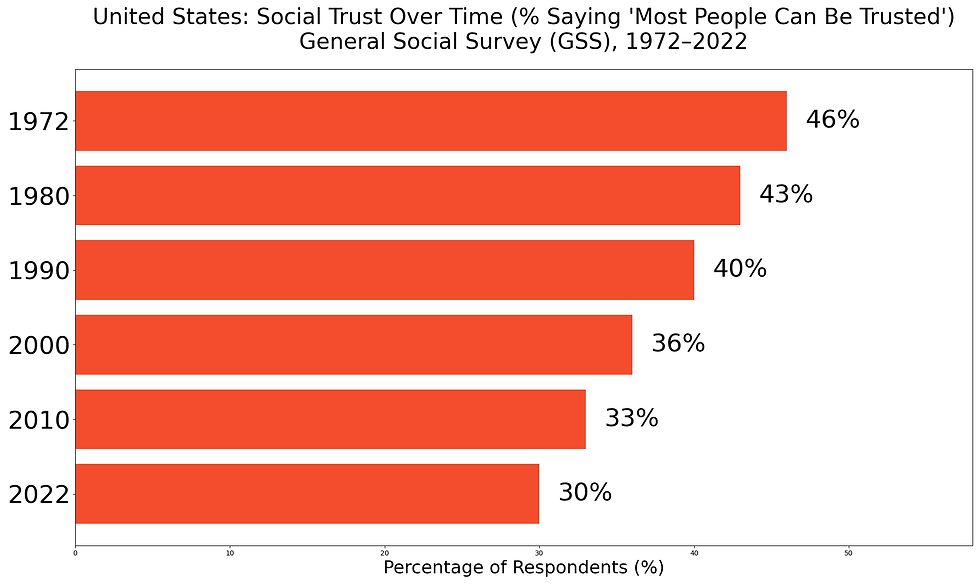
In the early 1970s, nearly half of Americans believed most people could be trusted. Today, that number sits closer to 30%.
Institutional trust has fallen even more sharply. In the 1960s, over 70% trusted the federal government to do what is right most of the time. Today, fewer than one in four say the same.
Yet America is not monolithic. Some communities retain high civic participation and strong local trust. Others struggle with polarization and fragmentation.
For retirees, investors, and families, this means geography within a country matters.
Trust in the U.S. has not disappeared. It has become uneven.
4. Duty, Harmony & Selective Trust in East Asia
Trust doesn’t always look the same.
In 🇯🇵 Japan, general social trust sits in the moderate range — yet public order is extraordinary. Lost wallets in Tokyo routinely find their way back to owners, often with cash intact.
In 🇨🇳 China, surveys often show high confidence in central institutions, while interpersonal trust relies more heavily on established relationships — what is known as guanxi.
🇰🇷 South Korea combines strong civic engagement with fluctuating institutional confidence.
In this region, trust may be less about generalized optimism and more about duty, reputation, and social harmony.
The result? Low crime, strong compliance, and efficient public systems — even when strangers aren’t automatically assumed to be trustworthy.

5. Latin America: Trust Under Pressure
In much of Latin America — including 🇧🇷 Brazil, 🇲🇽 Mexico, and 🇵🇪 Peru — fewer than one in four citizens typically say most people can be trusted.
Crime concerns and corruption perceptions weigh heavily on social confidence. But averages conceal exceptions.
🇺🇾 Uruguay stands apart with comparatively stronger institutions and higher reported trust levels than many regional neighbors.
Where generalized trust is lower, family networks grow stronger. Gated communities, informal economies, and tight-knit circles compensate for weaker institutional confidence.
In some countries in the region, fewer than 20% of citizens express trust in their national government.
Trust, when strained, turns inward.

6. Community First: Africa & the Middle East
In parts of 🇷🇼 Rwanda, 🇳🇬 Nigeria, and 🇪🇬 Egypt, surveys show a familiar pattern: lower generalized trust in strangers, but strong trust within family, tribe, or religious community.
In Rwanda, institutional trust has risen in recent decades following national rebuilding efforts. In more fragile states, confidence in formal systems remains limited.
In some countries, people report trusting neighbors more than police. This is an important distinction.
When national systems are weak, community becomes the primary safety net. Trust doesn’t vanish. It concentrates.

Comments