Do recent black immigrants to the US outperform native blacks?
- snitzoid
- 2 hours ago
- 3 min read
The economist Thomas Sowell has argued for many decades that, despite years of mistreatment at the hands of whites, until the late 1960s, the Black culture had proved itself to be remarkably resilient, clocking cohabitation rates (even when it was illegal to marry), employment rates, crime rates, similar to the White population (and closing the education gap).
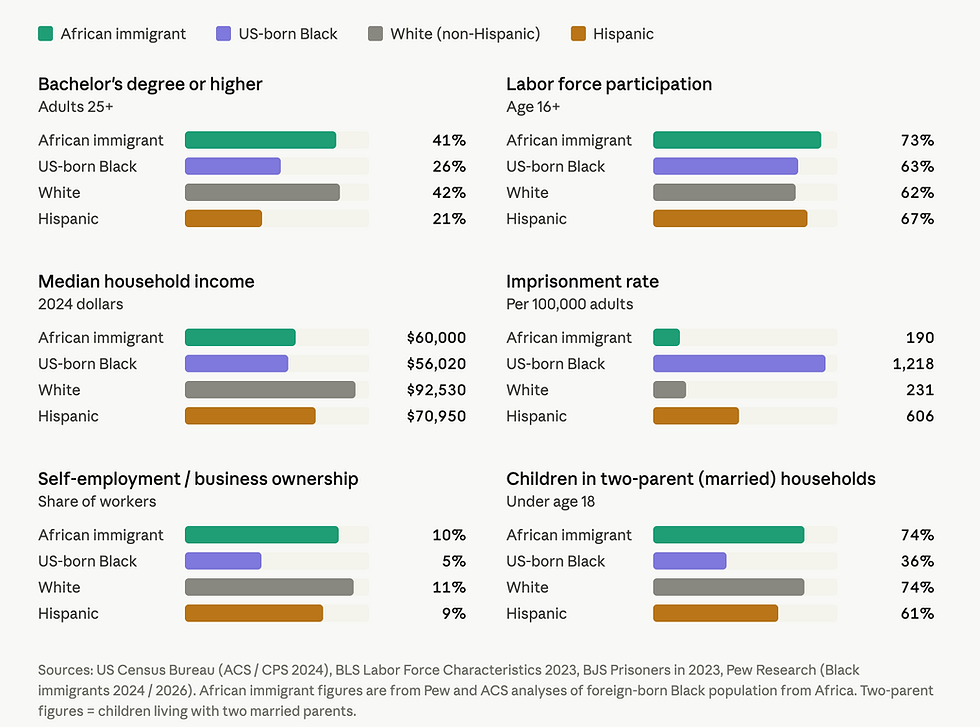
He argues that Blacks aren't doomed by the color of their skin to fail. He also points out that recent Black immigrants have thrived in the US, calling into question whether one's skin color is an automatic disqualifier in this country to success.
I've attached below some nuance on Sowell's hypothesis.
1. Employment and Unemployment
Sowell's Claim: Prior to the late 1960s, Blacks had similar rates of employment and unemployment to whites.
Where it’s accurate: If you look back to the late 19th century and the first half of the 20th century, the labor force participation rate for Black men was often equal to or higher than that of white men. For instance, in the 1900 through 1930 censuses, Black unemployment was frequently lower than or equal to white unemployment.
The Nuance: This wasn't necessarily a sign of economic parity; it was a function of necessity. In the agrarian South, Black Americans had to work to survive, often under sharecropping systems or in low-wage domestic and agricultural labor.
The Shift: Sowell argues that the minimum wage laws (like the Fair Labor Standards Act updates in the 1950s and 60s) and welfare expansion priced low-skilled Black youth out of the market, causing the unemployment gap to widen dramatically by the late 1960s. Mainstream economists agree that a gap widened significantly during this era, though they heavily debate the causes, often pointing to the decline of manufacturing jobs in the cities (deindustrialization) and ongoing workplace discrimination.
2. Crime Rates
Sowell's Claim: Prior to the 1960s, crime rates among Black Americans were much closer to those of white Americans.
Where it’s accurate: Sowell frequently highlights that the massive spike in violent crime and the dramatic divergence in racial crime statistics occurred during the mid-to-late 1960s and 1970s. Historical data confirms that urban violent crime rates rose sharply across the board during this period, and disproportionately so in urban Black communities.
The Nuance: While the gap widened dramatically in the 1960s, it is historically inaccurate to say crime rates were virtually identical before then. Criminologists and historians note that dating back to the early 20th century, Black Americans in major cities did have higher recorded arrest rates for violent offenses than whites, a trend heavily compounded by intense poverty, high housing density in segregated neighborhoods, and documented biases in early urban policing.
3. Education After the Great Migration
Sowell's Claim: After migrating to northern cities, Black Americans reached a similar level of education as whites.
Where it’s accurate: The Great Migration (1910–1970) dramatically closed the racial education gap. Black families moving North gained immense access to better-funded, non-segregated school systems compared to the Jim Crow South. Studies show that children of migrants gained an average of nearly a full year of additional schooling just by relocating North.
The Nuance: While the gap narrowed substantially, it did not entirely disappear. Northern schools, while legally integrated in many places, became functionally segregated due to "redlining" (discriminatory housing and lending practices) and "white flight" to the suburbs. This concentrated Black students in underfunded inner-city school districts, preventing full parity in graduation rates and educational attainment with the broader white population.
Sowell uses these historical data points to argue that the cultural and economic trajectory of Black Americans was improving organically before major federal interventions, and that post-1960s policies (like the Great Society welfare programs) inadvertently disrupted that progress.
Comments