Globally when do the little shits get their first smartphone?
When I was 11, my dad gave me my first chain saw. It pretty obvious why I turned out with my head screwed on straight. Depression? I cause anxiety in others while continue to feel right as rain myself.
Where Children Get Smartphones the Earliest
World Population Review
Oct 6, 2026
The countries handing kids a phone before they hit their teens.
For most of history, the milestones of growing up were a first bike, a first job, a first car. Today, for hundreds of millions of kids, the defining one comes much sooner — and it fits in a pocket.
So where do children get their first smartphone earliest, and what happens next?
1. The English-Speaking World Goes First
Sapien Labs' Global Mind Project, which surveyed more than 100,000 young adults across 163 countries, reveals a clear geographic split in when childhood meets the smartphone.
🌎 In English-speaking countries, children typically get their first smartphone at around age 11.
🌍 The global average sits at 13 — a full two years later.
🌏 Across Africa, South Asia, and the Middle East, first phones typically arrive between ages 14 and 16.
Western Europe and Latin America also land on the earlier side of the global divide.
💡 The detail that stands out: the gap between the earliest and latest regions amounts to roughly four years — nearly the entire span of adolescence.

2. Every Generation Gets Them Younger
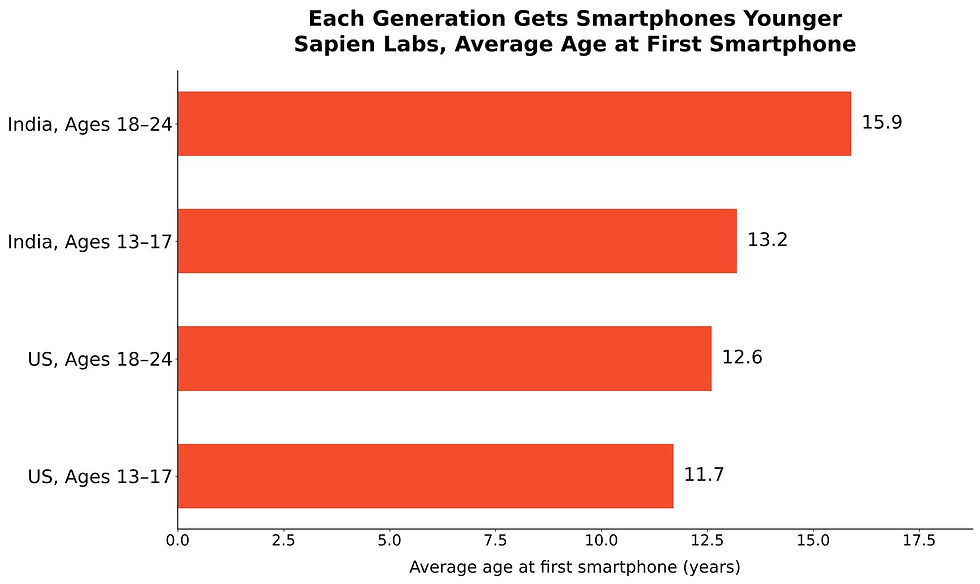
The same research compares today's young adults with today's teenagers — and the trend runs in only one direction.
🇺🇸 Americans now aged 18–24 got their first smartphone at an average age of 12.6. Today's US 13–17-year-olds got theirs at 11.7.
🇮🇳 In India, the shift is even steeper: from 15.9 years among young adults to 13.2 years among current teens.
That's nearly three years younger in India across a single generational step — while the US, already early, crept closer to age 11.
🔮 A pattern worth watching: if India's pace holds, the four-year gap between the world's
earliest and latest regions could narrow sharply within a single generation.
3. Britain's Age-11 Tipping Point
In the United Kingdom, the move from primary to secondary school has become the unofficial starting line for phone ownership.
🇬🇧 According to Ofcom's 2026 report, 56% of British 10-year-olds own a smartphone.
🇬🇧 By age 11, that figure jumps to 83% — a 27-point leap in a single year.
The timing isn't a coincidence: age 11 is when most British children begin secondary school, and Ofcom identifies that move as the moment many get their first phone.
🔎 Worth keeping in mind: the first day of secondary school and the first phone now tend to arrive together — making it one of the clearest technology milestones of modern childhood.

4. In America, How Kids Use Phones Matters Most
A University of South Florida survey of more than 1,500 children aged 11 to 13 found that more than 70% of 11-year-olds already own a smartphone.
👧 Kids who frequently posted publicly on social media were twice as likely to report moderate or severe depression symptoms — 54%, against 25% for those who didn't.
😰 Anxiety followed the same pattern, at 50% for frequent public posters versus 24% for others.
Yet children who owned their own phone actually reported lower depression and anxiety, and more in-person time with friends, than those without one.
One in four children also sleep with a phone in bed — averaging 8.6 hours of sleep a night, against 9.3 hours for kids who keep their phone in another room.
🎯 The surprising part: the phone itself wasn't the clearest warning sign — what children did with it was.

5. The Cost of an Early Start
Back at the global level, Sapien Labs tracked how young adults are faring depending on when they got their first phone.
👩 Among young women who got a smartphone at age 5 or 6, 48% reported severe suicidal thoughts as adults, compared with 28% of those who waited until 13.
👨 Among young men, the figures were 31% for early owners against 20% for those who started at 13.
Researchers attributed roughly 40% of the overall effect to early social media access — rising to as much as 70% in English-speaking developed countries.
⚠️ The honest takeaway: the countries handing over phones earliest are also the ones where early social media exposure appears to do the most harm.

6. Schools Push Back
As phones arrive earlier, classrooms around the world have started drawing a line.
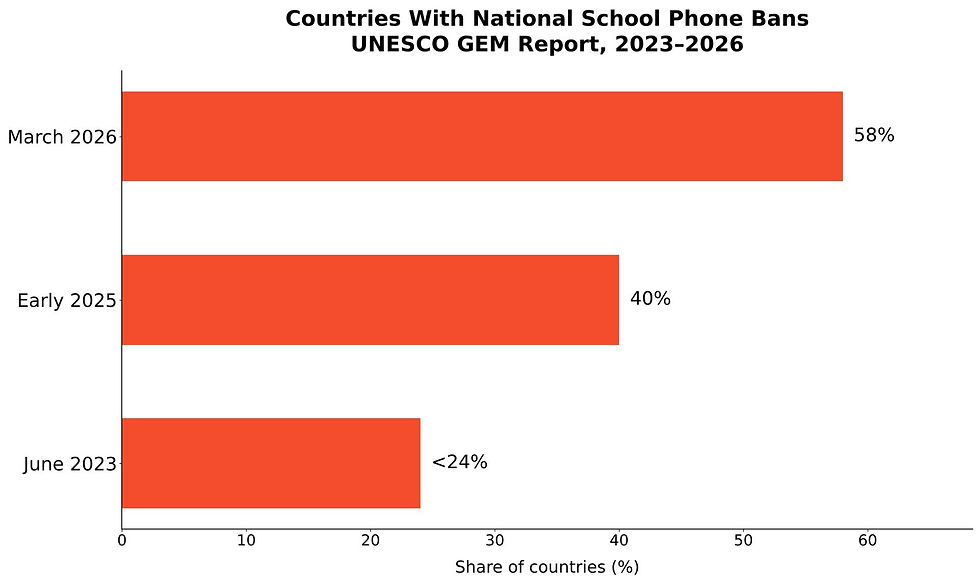
🎓 In June 2023, fewer than one in four countries had national bans on phones in schools.
📈 By early 2025, that share had grown to 40% — and by March 2026, UNESCO counted 114 education systems with bans, or 58% of countries worldwide.
🇺🇸 The United States has no national rule, but 39 states have introduced measures requiring schools or districts to limit phone use.
🇪🇸 In Spain, the shift is showing up at home too: phone use among 10- and 11-year-olds fell by 3.7 and 4.0 points in 2025, the steepest drops of any age group.
📊 What comes next: Bolivia, Costa Rica, Croatia, Georgia, the Maldives, and Malta joined the list in just the past year — the movement shows no sign of slowing.
7. Australia Raises the Bar
🇦🇺 Australia became the first country to bar under-16s from major social media platforms, with its law taking effect on December 10, 2025.
📉 In the first month alone, platforms removed roughly 4.7 million accounts belonging to Australian children.
💻 Meta accounted for about 550,000 of those, across Instagram, Facebook, and Threads — meaning the large majority came from other platforms such as TikTok, Snapchat, and YouTube.
France, Malaysia, Indonesia, and several other European nations are now weighing similar rules of their own.
🌏 The real shift: the debate is moving beyond when children should get a phone toward what they should be allowed to do on it.

Comments