It's Gallup Day at the Report!
- snitzoid
- Apr 28
- 2 min read
1. Congress' Approval Near Record Low
Line Chart: Americans' approval ratings of Congress, 1974-2026.
The Data: Just 10% of Americans approve of the way Congress is handling its job, just above the all-time low of 9%. Eighty-six percent disapprove, tying the high in Gallup's trend.
More Context: Congressional approval has averaged 28% since 1974 and has remained below 30% for most of the past five years, with disapproval generally elevated.

2. Young U.S. Men and Women Diverging Politically
Multiple Line Chart: Leaned party ID of U.S. young adults, by gender.
The Data: In 2025, 64% of U.S. women aged 18 to 29 identified as Democrats or leaned Democratic, compared with 21% who identified as Republicans or leaned Republican. Among young men, 47% identified as Republicans or Republican leaners and 42% as Democrats or Democratic leaners.
The Trend: The gender gaps in leaned party identification among young adults have widened over time. From 2000 to 2015, young men and young women typically held more similar political views. Today, young women tend to identify as Democratic, while young men now tilt Republican.

3. Where Potential Migrants Want to Move
Multiple Line Chart: Top desired locations for potential migrants.
The Data: While the U.S. remains the top preferred destination globally, well ahead of Canada at 9%, its appeal has declined across several regions, including Latin America and the Caribbean, sub-Saharan Africa, and Southeast Asia.
More Context: In 2025, 15% of adults worldwide who said they would like to move permanently to another country named the U.S. as their preferred destination. This figure is down from 24% in 2007-2009 and the lowest reading in Gallup's nearly 20-year trend.

4. Top Desired Destinations for Young People
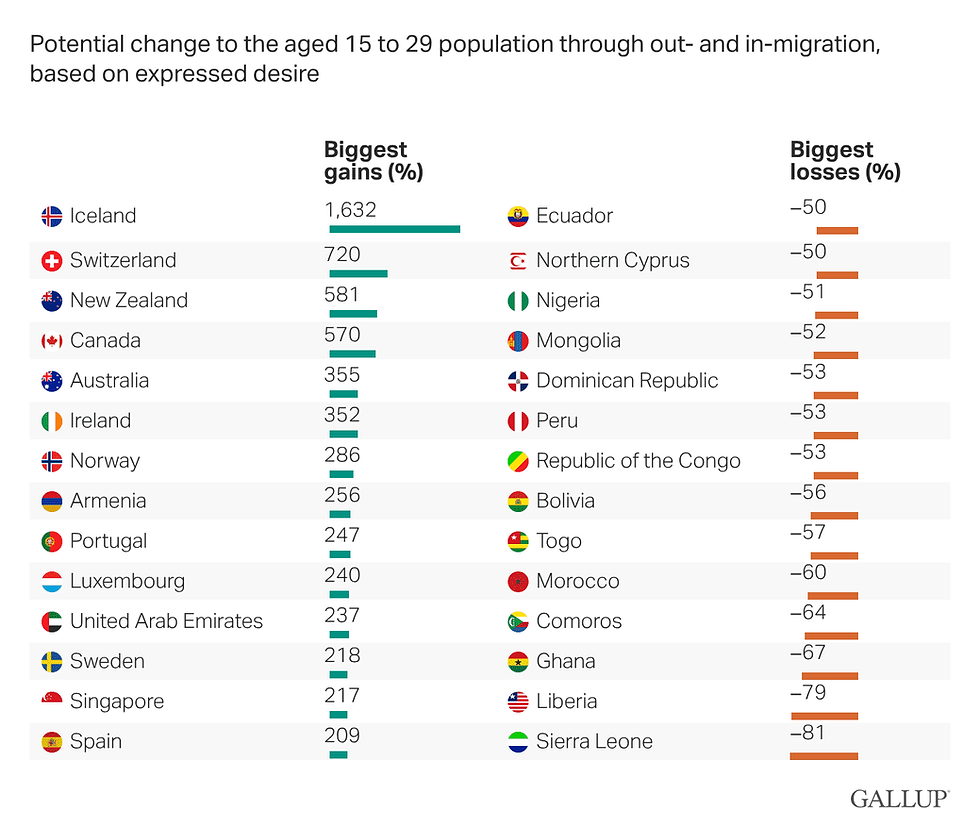
Table: Biggest potential migrant youth gains and losses.
The Data: Gallup's Potential Net Youth Gain Index shows that the largest potential population gains among adults aged 15 to 29 are concentrated in high-income countries, led by Iceland (+1,632%), Switzerland (+720%), New Zealand (+581%) and Canada (+570%).
The Losses: The steepest potential youth population losses are concentrated in low- and lower-middle-income countries, including Sierra Leone (-81%), Liberia (-79%), Ghana (-67%) and Comoros (-64%).
5. Young Americans' Religious Trends
Line Chart: Religious importance among young adults, by gender.
The Data: In 2024-2025, 42% of young men in the U.S. (aged 18 to 29) said religion was “very important” in their lives, compared with 29% of young women.
More Context: This is a change from the early 2000s, when young women were more likely than young men to say religion was very important in their lives. The recent shift is concentrated among young adults. In older age groups, women remain at least as religious as men on this and other measures. The recent increase in young men's religiosity is especially notable because other age and gender groups are generally at or near their lows in Gallup's trends.

Comments