M.B.A. Pay Is Drifting Down—and So Is Demand for the Degree
- snitzoid
- 2 minutes ago
- 3 min read
Do most profs at these schools understand AI better than you do? Sure! Haha. Are they becoming obsolete? They better watch out.

M.B.A. Pay Is Drifting Down—and So Is Demand for the Degree
Corporate recruiters in survey forecast lower starting salaries and AI disruption
By Ray A. Smith, WSJ
June 25, 2026
This graduation season, many newly minted M.B.A.s are finding fewer job openings and lower starting salaries.
A new report shows the starting median salary for master of business administration degree holders this year is projected to fall to $120,000, from $125,000 in 2025, according to a survey of more than 600 corporate recruiters by the Graduate Management Admission Council, a nonprofit association of 228 business schools.
Recruiters also forecast that salaries for holders of other business master’s degrees would slide about 10% to $82,500 a year, from $92,500.

Job prospects for new M.B.A.s are also uncertain.
After last year’s graduation season, even some top-tier M.B.A. graduates struggled to land jobs several months after leaving their universities. This year, over a third of employers surveyed said they planned to hire more M.B.A.s than last year. In 2025, only 13% of employers surveyed ended up hiring more M.B.A.s than they had the prior year.
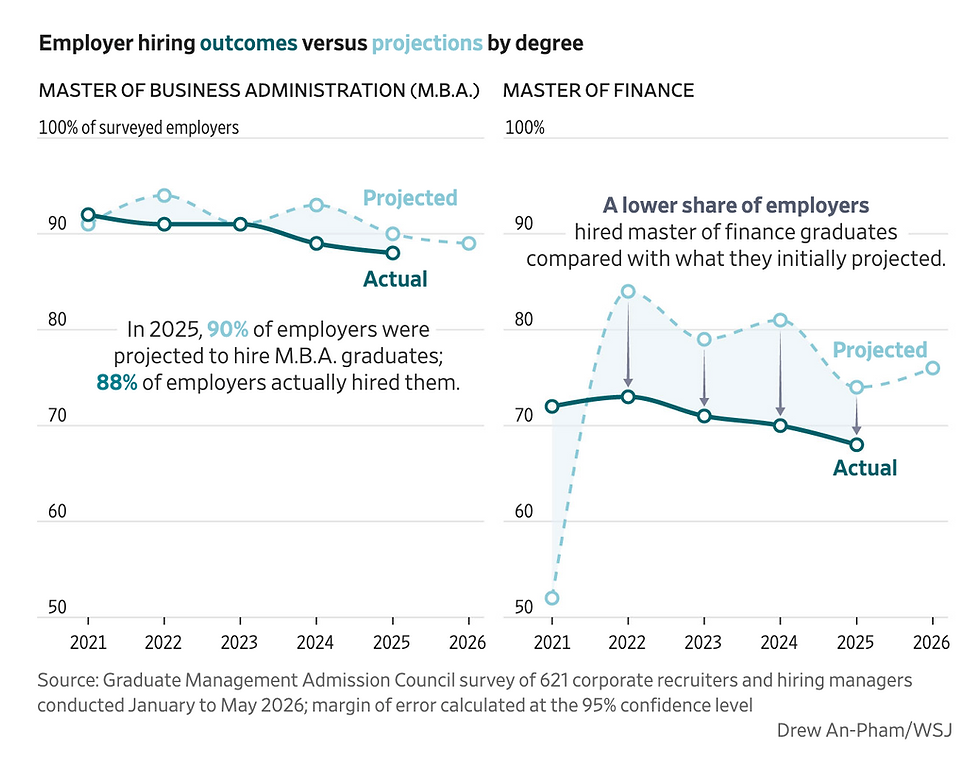
Despite that optimistic recruiting outlook, GMAC researchers point out that historical data shows that employers often predict greater hiring of M.B.A.s for any given year than they end up making. While 90% of recruiters predicted they would hire graduates of M.B.A. programs last year, 88% actually ended up doing so.
The hiring gap was wider for other popular business degrees. For example, while 74% of employers projected they would hire people with a master of finance degree last year, 68% followed through on those hires.
While GMAC reported that employers said the fundamental value proposition of a business degree remains intact, they also increasingly worry about graduates’ artificial-intelligence proficiency.
Tim Westerbeck, co-chairman of the higher-education consulting firm Eduvantis, said the M.B.A. was built for graduates to get a foothold in consulting and finance with analyst jobs—the very positions that AI is structurally absorbing. When even the top 20% of M.B.A. graduates can’t find the type of roles they want, the market for their degrees is changing in a permanent way.
While “this isn’t an obituary, the market for M.B.A.-level work may be shrinking, permanently, to a smaller size,” Westerbeck said.
Several outside factors that weighed on hiring last year—including fears of inflation or recession—aren’t having as great an influence this year, according to the recruiters surveyed. But AI looms large.
One in three corporate employers polled said AI was beginning to reorder hiring plans, with at least some entry-level jobs replaced by the technology. On top of that, older workers have been staying put, leading to less turnover that would let graduates get a foot in the door.
Even so, GMAC’s analysis found that America’s M.B.A. graduates are still expected to outearn other hires who come directly from industry and that holders of M.B.A.s continue to get a starting-salary premium compared with job applicants with only bachelor’s degrees.
“The bottom rungs young grads depend on are being pulled away,” said Gad Levanon, chief economist at the Burning Glass Institute, a labor-market think tank focused on the future of work. Business-school graduates often funnel into finance, consulting, tech and professional services, “exactly the sectors where employment is declining the most,” he added.
Particularly affected this year: international students who earned M.B.A.s in the hope of landing a job in the U.S. Among American employers polled, about four in 10 said they would decrease hiring of international job candidates because of tightening U.S. government policies regarding immigration and H-1B visas.
More international students have flocked to business-school programs in Western Europe and Asia in the past couple of years. Employers there appear more than willing to hire the influx of talent from abroad. Four out of five employers surveyed by GMAC that are based in Western Europe or Asia were willing to hire people with graduate degrees in management who require additional legal documentation to work there.
Comments