Snitz examines US crime vs the rest of the globe!
- snitzoid
- 6 hours ago
- 6 min read
I bet you've seen a bunch of graphs like this one. I could add more EU nations and the picture is often the same. The US is a cesspool of violence. Or is it? Has the US media ramped things up to scare you and create engagement.
I did a deep dive with Claude to get to the answers. Before we start, you're welcome!
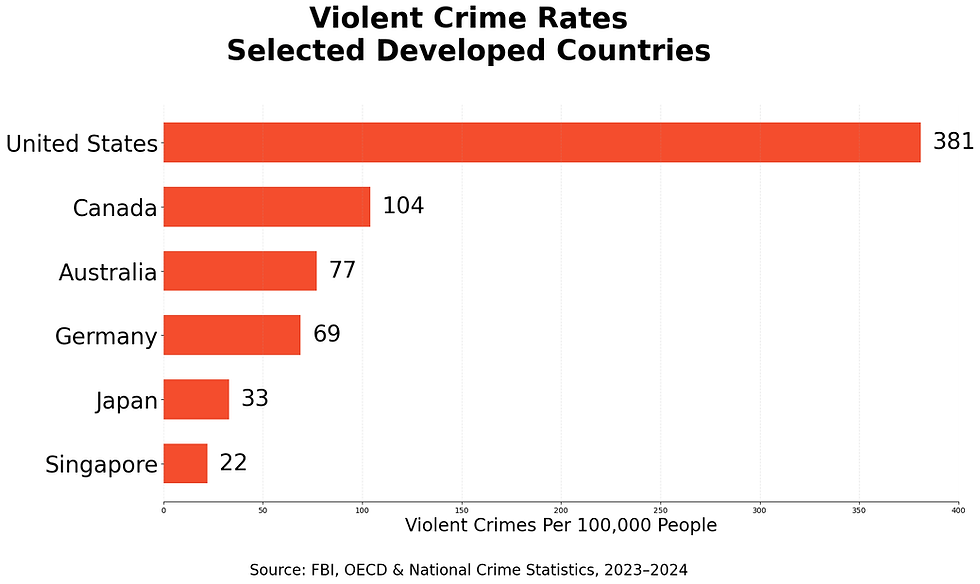
First off, we are globally speaking middle of the road. Africa, Latin America are all worse...much worse. On the other hand, much of Europe puts us to shame. Other extremes are places like Japan and Singapore where crime is virtually non existent.
So what's going on? First off, guns are going on. There are roughly (2026) 500 million civilian owned guns in the US. The math: about 340 million people of which 285 million are over the age of 12. Ergo, counting middle schoolers to adults there are almost 2 guns per person. BAM!
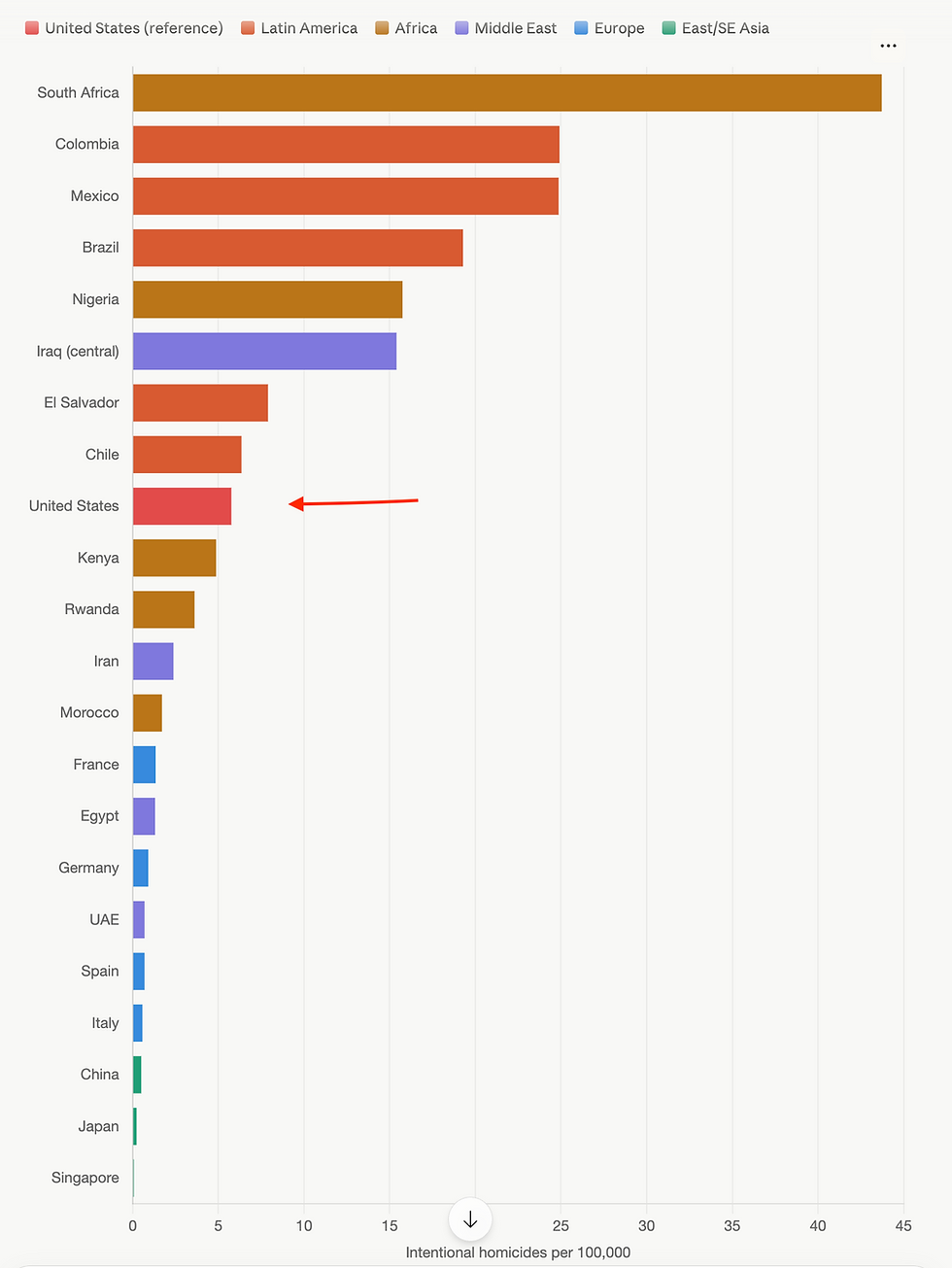
Ironically, the violent non gun crime rate in the US is almost identical to EU nations. Yup, it's the guns Holmes! Would things be better off without guns. My take...YES! Did our founders envision this sheet? Err... to defend against government tyranny. Try taking arms now against the armed forces...good luck with that.
Hold on, you think I want to ban guns? No! I certainly support prudent gun control (no for folks with criminal or serious mental health backgrounds). On the other hand, the horse has likely left the barn. Taking guns from the bad guys is virtually impossible. Are we f-cked? Kind of.
A few key facts you might not be aware of. Four of five people killed by a gun is by suicide. Mental health programs that are geared to reducing suicides are highly effective and statistically save 10 times more lives than gun control measures.
Why Japan and Singapore avoid this problem? First, if you commit a crime you bring shame and societal expulsion to your family. The pressure to conform to positive law abiding behavior is intense. Also the tolerance for crime is nil and punishment is swift and severe. Sinagpore still has public cainings which routinely require hospitalization because of the severity.
Want more cowbell: More notes from Claude below.
On why America shows higher violent crime, start with the metric. That 381-per-100,000 "violent crime" figure is a different animal from the homicide rates in the other charts. The FBI's category bundles homicide, rape, robbery, and aggravated assault, and the U.S. defines and records those broadly. Cross-national "violent crime" comparisons are close to meaningless because every country draws those category lines differently and has different reporting rates — what counts as an aggravated assault in Chicago may not be logged at all elsewhere. The chart that stacks U.S. "violent crimes per 100k" next to other countries is comparing apples to a different fruit.
The metric that actually travels across borders is the homicide rate, because bodies are hard to hide and definitions converge. There the U.S. sits around 5–6 per 100,000 — roughly four to five times Western European peers (their 0.4–1.3 range), but a small fraction of Latin America's worst. The single biggest driver of that gap versus other rich nations is firearms. The U.S. non-gun homicide rate is much closer to European levels; it's the gun homicide rate that blows the number out. More firearms in circulation than people, easier access, and far more lethal outcomes from disputes that elsewhere end in a fistfight. Secondary contributors: concentrated poverty and inequality, segregated high-disadvantage neighborhoods, illicit drug-market violence, a thinner safety net, and policing fragmented across ~18,000 agencies. The newsletter gets one real thing right — the U.S. national average is misleading because violence is hyper-concentrated. Most suburban and rural America runs at Western-European homicide levels; a handful of neighborhoods carry the average.
region by region:
South America (plus Central America and Mexico) — mostly correct. In homicide terms it is genuinely more dangerous than the U.S., often by multiples. And here's the trap in the newsletter: it shows percent decline, not absolute level. El Salvador's 92% drop is real, but it started near 100 per 100,000. A spectacular decline from a catastrophic base can still leave you at or above the U.S. rate. So "crime is falling fast" and "still more dangerous than the U.S." are both true at once.
Africa — too broad to assume. It's the most heterogeneous case. South Africa runs around 45 per 100,000, far worse than the U.S. But Morocco, Botswana, Rwanda, and much of North Africa are relatively low — some comparable to or safer than the U.S. for ordinary crime. Note also that the Africa chart uses the Global Peace Index, which folds in militarization and conflict, not just street crime, so it's measuring something broader than "will I get mugged."
Middle East — this is where the assumption mostly breaks. The Gulf states (UAE, Qatar, Oman, Saudi, Kuwait) have among the lowest homicide and street-crime rates on earth — routinely safer than the U.S. or Western Europe for everyday violence. The "danger" people associate with the region is war, terrorism, and political instability (Syria, Yemen, Iraq, Gaza) — a completely different axis from ordinary crime. The newsletter's own perceived-safety chart puts the UAE at the very top (85). So "Middle East = dangerous" conflates conflict risk with crime risk.
One methodological flag worth keeping in mind: the piece hops across six incompatible yardsticks — percent decline, homicides per 100k, violent crimes per 100k, Global Peace Index, CCTV density, and Numbeo. Numbeo is crowdsourced perception, not recorded crime — it's vibes, not records. Each chart is fine in isolation, but you can't stack them into a single ranking, which is the impression the layout invites.
Want me to pull current homicide-per-100k figures for a specific set of countries so you've got a clean apples-to-apples table?
Sure pick some representative nations in europe, latin amercian and africa to compare to. In the Middle East compare Iraq, Iran and Egypt to the UAE which are vastly different crime landscape. Also include China, Japan and Singapore.
9:56 AM
The U.S. at 5.76 lands in a revealing spot — middle of the pack, not the bottom. It sits well above every European, East Asian, and Gulf country, but below most of Latin America and South Africa. That single fact reframes the newsletter: the U.S. is safer than the Western Hemisphere average and dramatically more dangerous than its rich-world peers. Both halves of that are true at once.
Europe behaves exactly as you'd expect — France 1.34, Germany 0.91, Spain 0.69, Italy 0.57. The U.S. runs roughly four to eight times higher than Western Europe. That gap is the firearms story I mentioned: strip out gun homicides and the U.S. number collapses toward European levels.
Latin America confirms your assumption is broadly right. Colombia (24.9), Mexico (24.9), and Brazil (19.3) sit four to five times above the U.S. El Salvador is the trap the newsletter set: its 92% "decline" is real, but it fell to 7.9 — still above the U.S. So "fastest-improving" and "more dangerous than America" coexist. Chile (6.3) is the regional outlier, basically at U.S. level.
Africa is the most heterogeneous, which is why a blanket "more dangerous" assumption fails. South Africa (43.7) is genuinely catastrophic — the worst on this chart. Nigeria (15.7) is high. But Kenya (4.9) is below the U.S., and Morocco (1.7) and Rwanda (3.6) are firmly below it. Morocco is safer than France by this measure. So "Africa is dangerous" is wrong as a generalization; specific countries are.
The Middle East is where your instinct flips hardest, and your country picks illustrate it perfectly. Iraq's central region (15.4) is genuinely dangerous — but that figure is inflated by insurgency and sectarian violence that blurs the line between homicide and armed conflict. Iran (2.4) and Egypt (1.3) are below the U.S. And the UAE (0.69) is among the safest places on the entire chart — safer than Spain, safer than France, on par with the calmest of Europe. The "danger" Westerners associate with the region is war and instability (Syria, Yemen, Gaza), not street crime. Conflict risk and crime risk are different axes.
Asia anchors the safe end. China (0.50), Japan (0.23), and Singapore (0.069) are the floor. Singapore and the UAE are effectively tied for safest here.
Three caveats worth flagging on the data itself. The Iran (2014), Egypt (2017), and China (2020) figures are stale — those governments report infrequently, and China's in particular is widely treated as understated given limited transparency. Iraq's number is the messiest, because counting conflict deaths as "homicide" is exactly the definitional problem that makes the metric wobble in war zones. And South Africa, Nigeria, and the Gulf states have very different reporting quality. The European, American, and East Asian figures are the most reliable; treat the rest as directional.
Net answer to your original question: America's elevated rate versus its peer nations is overwhelmingly a firearms-and-inequality story, and it's hyper-concentrated — but on a global scale the U.S. is squarely mid-tier, safer than most of Latin America and parts of Africa, and far more dangerous than Europe, East Asia, and the Gulf.
Comments