What 3 Billion Gamers Reveal About Our Future
- snitzoid
- 3 days ago
- 7 min read
I know what your thinking, I hope my son or prospective son in law spends 4 hours per day playing video games.
The question is, how 'f-cked up" are people who play? I've attached Claude's review of the scientific literature after the article below.
The short answer. A moderate amount of gaming is neutral to slightly positive on cognition and neural development. A lot of game is bad for your mental health.
I think people who spend a great deal of time playing video games are retarded. Oh, hold on...that was completely out of line. Very sorry.
What 3 Billion Gamers Reveal About Our Future
World Population Review
Gaming is no longer just a hobby. It's a $200+ billion global industry that shapes entertainment, technology, education, and even national economies. More than 3.4 billion people now play video games in one form or another, yet the way they play varies dramatically from country to country.
Some nations have turned gaming into a cultural institution. Others have become esports powerhouses or mobile gaming giants almost overnight.
Understanding these trends offers fascinating insight into technology, demographics, consumer spending, and the future of digital entertainment.
1. 🇰🇷 South Korea: Where Gaming Became a National Passion
Few countries have embraced gaming quite like South Korea. Thanks to lightning-fast internet, widespread PC cafés (PC bangs), and a culture that celebrates competitive gaming, the country has become one of the world's gaming capitals.
Professional gamers enjoy celebrity status, major tournaments fill stadiums, and esports broadcasts attract millions of viewers. Games like League of Legends, StarCraft, and Valorant helped transform gaming from a pastime into a legitimate career.
South Korea also hosts some of the world's largest game developers, including Krafton and Nexon, whose titles reach players across the globe.
💡 Why it matters: South Korea demonstrates how investment in technology and digital infrastructure can create entirely new industries.
🎯 Fun fact: The country officially recognized esports players as professional athletes years before many traditional sporting organizations took competitive gaming seriously.

2. 🇨🇳 China: Gaming at an Unmatched Scale
No country has more gamers than China. With well over 650 million players, its gaming market is larger than the populations of Europe and North America combined.
📱 Mobile gaming dominates daily life. Millions play quick matches while commuting, waiting in line, or relaxing at home. Chinese companies such as Tencent and NetEase have grown into global gaming giants, investing in studios around the world and publishing many of today's biggest titles.
Government regulations—including limits on gaming time for minors—have attracted international attention, but they have done little to slow China's influence on the industry itself.
💡 Why it matters: China's gaming market increasingly shapes which games get made, how they're monetized, and where investment flows.
🌏 Surprising fact: Tencent owns or has major stakes in dozens of leading international game studios, making it one of the most influential companies in gaming history.

3. 🇯🇵 Japan: The Birthplace of Gaming Legends
Modern gaming would look very different without Japan.
🎮 Nintendo, Sony, Sega, Capcom, Square Enix, and Bandai Namco helped create many of the world's most recognizable characters—from Mario and Zelda to Pokémon, Sonic, and Final Fantasy.
Unlike many countries that focus heavily on online competition, Japan has long valued creative storytelling, innovative gameplay, and memorable characters. Even decades-old franchises continue attracting new generations of players.
Although Japan's gaming population is smaller than China's or America's, its influence far exceeds its size. Many of today's game designers still study Japanese classics for inspiration.
💡 Why it matters: Japan reminds us that creativity often matters more than market size.
⭐ Did you know? The Nintendo Switch has sold well over 150 million units, making it one of the best-selling game consoles ever produced.

4. 🇺🇸 The United States: Gaming Meets Big Business
The United States combines massive consumer spending with world-leading game development. American studios have created blockbuster franchises such as Call of Duty, Grand Theft Auto, The Elder Scrolls, and Fortnite.
🎥 Gaming is also becoming mainstream entertainment. Millions watch livestreams on Twitch and YouTube, while major esports events regularly sell out large arenas.
The industry supports hundreds of thousands of jobs across software development, design, animation, music, marketing, and artificial intelligence.
Perhaps most importantly, the U.S. has become the center of gaming innovation, with advances in cloud gaming, virtual reality, and AI reshaping what games can become.
📈 Trend to watch: Gaming increasingly overlaps with movies, music, education, and social media, blurring the line between entertainment and everyday life.

5. 🌏 Mobile Gaming Is Changing the World
The biggest gaming revolution isn't happening on expensive PCs—it's happening on smartphones.
🇮🇳 India, 🇮🇩 Indonesia, 🇧🇷 Brazil, and 🇻🇳 Vietnam have added hundreds of millions of new gamers in just the past decade. Affordable smartphones and faster mobile internet have opened gaming to people who never owned traditional consoles.
Free-to-play titles like PUBG Mobile, Free Fire, Mobile Legends, and Honor of Kings dominate download charts across much of the developing world.
For many younger players, mobile isn't a second choice—it's their primary gaming platform.
💡 Why it matters: The next billion gamers are far more likely to play on phones than consoles.
📊 Amazing statistic: Mobile games now generate more revenue globally than PC and console gaming combined.

6. 🏆 Esports: The New Global Spectator Sport
Watching games has become almost as popular as playing them.
Competitive esports now attracts audiences measured in the hundreds of millions. Major tournaments for League of Legends, Counter-Strike, Dota 2, and Valorant rival traditional sporting events in online viewership.
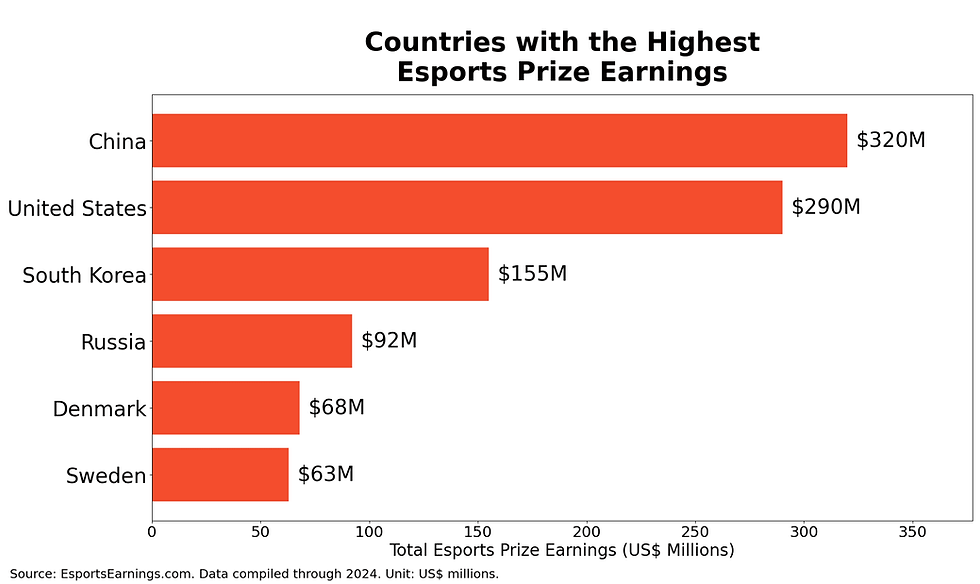
🌍 Countries including 🇰🇷 South Korea, 🇨🇳 China, 🇺🇸 the United States, 🇩🇰 Denmark, and 🇸🇪 Sweden consistently produce world-class teams.
Universities increasingly offer esports scholarships, while businesses invest billions into leagues, sponsorships, broadcasting, and event production.
💡 Why it matters: Esports is creating entirely new careers—not only for players, but also for coaches, analysts, broadcasters, software engineers, marketers, and event organizers.
🏅 Surprising fact: Prize pools for some esports tournaments now exceed those awarded at many famous traditional sporting events.
7. 🚀 The Future of Gaming May Be Closer Than You Think
Gaming continues to evolve at breathtaking speed.
🤖 Artificial intelligence is beginning to create smarter characters and more personalized experiences. ☁️ Cloud gaming allows players to stream high-end games without expensive hardware. 🥽 Virtual and augmented reality promise increasingly immersive worlds, while advances in graphics make digital environments more lifelike every year.
At the same time, gaming technology is finding uses beyond entertainment—from surgical training and military simulations to education, architecture, and workplace collaboration.
For younger generations especially, gaming is becoming less about "playing games" and more about socializing, learning, creating, and working inside digital spaces.
🔮 Looking ahead: The next decade may see gaming become one of the world's most important digital platforms—not just another form of entertainment.

Gaming has grown far beyond arcades and living rooms. It now influences technology, education, business, culture, and even how people connect across continents.
Today's biggest gaming nations may also become tomorrow's leaders in artificial intelligence, virtual reality, and the digital economy.
Claude's analysis:
That chart shows the current global gamer breakdown by age (Statista/ESA, 2025) — young adults 18–34 are the largest single bracket at 38%, and the under-18 crowd is actually a minority of the overall gaming population now, at 20%.

On cognitive development
The evidence here is more mixed-positive than the "gaming rots your brain" stereotype suggests:
The NIH-funded ABCD Study, tracking nearly 12,000 US youth, found that kids who played video games for three or more hours a day scored higher on cognitive tests of impulse control and working memory than kids who never played, with corresponding differences in brain activity during those tasks. Researchers were careful to note this is an association, not proof of causation. National Institutes of Health
A broader literature review of 40 studies (2020–2025) on 12–25 year-olds found video games showing positive effects on attention, working memory, executive functions, metacognition, and abstract reasoning — but the same review also found negative consequences for attention, self-regulation, and academic performance depending on genre and amount of play. It's not a blanket effect; type and dose matter. RSIS InternationalRSIS International
A University of Houston study of preteens (2.5 hrs/day average, some up to 4.5 hrs) found no link between gaming and cognitive or academic problems, regardless of how long kids played or what genre. ScienceDaily
At the other end of life, a 2026 meta-analysis found video-game-based interventions meaningfully improved cognitive function in older adults with mild cognitive impairment — gaming as a cognitive intervention, not just entertainment.
On mental health
This is where the picture gets more cautionary, but it's specifically tied to problematic/excessive gaming, not gaming per se:
A 2025 meta-analysis pooled prevalence data and found gaming disorder affects about 8.6% of adolescents worldwide, associated with social isolation, academic difficulties, anxiety and depression. PubMed Central
A 2025 longitudinal meta-analysis (30 studies, ~28,800 participants) found the relationship is bidirectional — gaming disorder predicts later depression and reduced life satisfaction, while depression, anxiety, and loneliness also predict later gaming disorder, but notably gaming disorder was not linked to subsequent anxiety once other factors were accounted for. ScienceDirectScienceDirect
Comparing casual/recreational vs. pathological gamers, one review found no significant depression difference between non-gamers and recreational gamers in either children or adolescents — the mental-health risk concentrates almost entirely in the disordered-use subgroup, not the general gaming population. Springer
On treatment: a 2025 meta-analysis of 21 controlled trials (1,360 participants) found CBT-based interventions produced significant reductions in gaming disorder symptoms and gaming time, plus moderate reductions in depression and anxiety, with effects holding at 90-day follow-up. ScienceDirect
Bottom line: for the average kid or young adult, moderate gaming looks cognitively neutral-to-beneficial (attention, working memory, executive function) and isn't strongly tied to worse mental health. The real risk factor is compulsive/disordered gaming (~1 in 12 adolescents), which behaves like other behavioral addictions — tangled up bidirectionally with pre-existing anxiety, depression, and loneliness rather than being purely caused by the game itself.
Comments