Which nations are building nuclear reactors?
One world. "Nuclear". Enough said. Think about it.
World Population Review
Aug 29, 2026
1. Who's Actually Building Reactors Right Now
Talk is cheap. Concrete and steel are not—and right now, one country is pouring far more of both into nuclear than anyone else on Earth.
🇨🇳 China has 37 reactors under construction, representing nearly 43 gigawatts of new capacity—more than every other nation's projects combined.
🇮🇳 India ranks a distant second with 8 reactors underway, part of a broader push to scale up its nuclear footprint this decade.
🇷🇺 Russia follows with 7 reactors in progress, continuing its role as one of the world's largest nuclear technology exporters.
🇪🇬 Egypt and 🇹🇷 Turkey are each building 4 reactors, marking their first serious entries into nuclear power.
Even the United Kingdom, with 2 reactors under construction, shows that Western nations are cautiously re-entering a field they'd largely abandoned.
📈 Worth noting: China's current buildout alone will add more nuclear capacity than the entire operating fleets of Russia and South Korea combined.

2. The Countries Already Running on Nuclear Power
Before the new race, there was the old one—and its results still define the global map today.
🇺🇸 The United States generates 826,100 GWh of nuclear electricity a year, more than the next two countries combined, despite building almost no new reactors in decades.
🇨🇳 China has rocketed to second place at 485,200 GWh, a figure that keeps climbing as new reactors come online.
🇫🇷 France produces 390,100 GWh—remarkable for a country roughly one-fifth the population of the U.S. or China.
🇷🇺 Russia generates 218,600 GWh, while 🇰🇷 South Korea produces 184,700 GWh from a fraction of the land area.
🇯🇵 Japan, still recovering its nuclear program after Fukushima, rounds out the top six at 94,100 GWh.
💡 The takeaway: Five countries account for more than two-thirds of all nuclear electricity generated worldwide—a concentration matched by very few other energy sources.

3. The Nations Whose Grids Run Almost Entirely on Atoms
Total output tells you scale. This next number tells you something more interesting: dependence.
🇫🇷 France draws 68.13% of its entire electricity supply from nuclear power—the highest share of any major economy on Earth.
🇸🇰 Slovakia follows closely at 64.43%, quietly one of the most nuclear-dependent nations in the world.
🇺🇦 Ukraine, even amid war, still generates 55.05% of its electricity from nuclear plants.
🇭🇺 Hungary sits at 46.2%, 🇨🇿 Czechia at 42.05%, and 🇰🇷 South Korea at 31.01%—each relying on nuclear for roughly a third to nearly half of their power.
For contrast, the U.S. figure is just 17.72%—proof that raw output and dependence are two very different stories.
🔎 A striking fact: If France's grid ever needed to run without nuclear power, it would have to replace more electricity overnight than most countries produce from all sources combined.

4. The Reactor Count: A Different Way to Measure Power
Gigawatt-hours measure output. This section measures something simpler: how many individual reactors each country actually operates.
🇺🇸 The United States runs 94 reactors—more than any other nation, even though many are decades old.
🇨🇳 China operates 60, a number that has grown faster than any other country's fleet over the past two decades.
🇫🇷 France runs 57 reactors, 🇷🇺 Russia operates 34, and 🇰🇷 South Korea runs 26.
🇨🇦 Canada rounds out the top six with 17 reactors, generating over 13% of its national electricity.
The reason the U.S. leads here despite similar output to China is fleet age: American reactors, on average, are larger and older, generating enormous output per unit.
📊 Something to consider: China now operates nearly two-thirds as many reactors as the U.S.—despite starting its nuclear program decades later.

5. Europe's Nuclear Divide
Nowhere is the nuclear debate more visible than in Europe, where neighboring countries have taken wildly different paths.
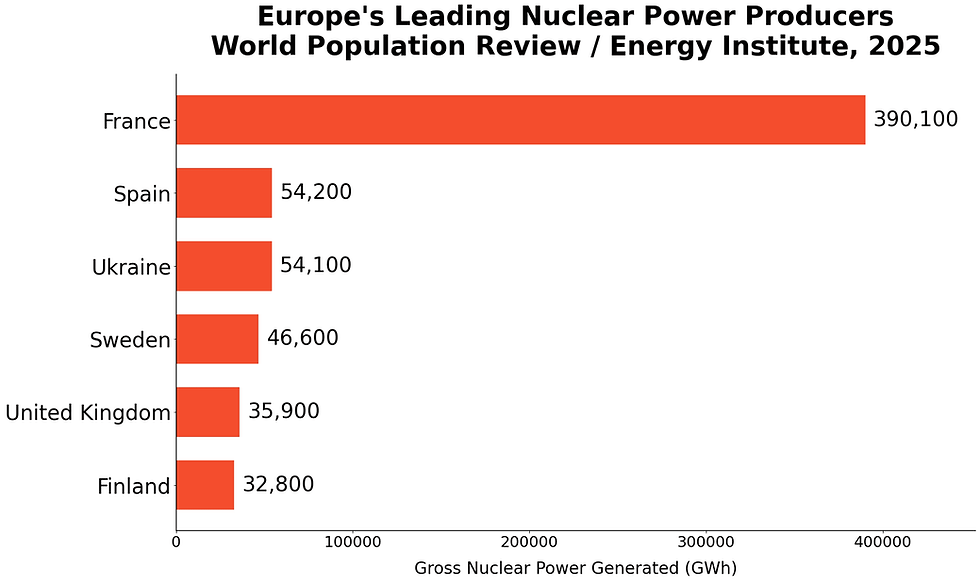
🇫🇷 France towers over the continent at 390,100 GWh of generation—more than every other European nuclear producer combined.
🇪🇸 Spain and 🇺🇦 Ukraine are next, each generating just over 54,000 GWh despite very different political circumstances.
🇸🇪 Sweden produces 46,600 GWh, 🇬🇧 the United Kingdom 35,900 GWh, and 🇫🇮 Finland 32,800 GWh.
What the numbers don't show: Germany, once Europe's second-largest nuclear producer, now generates zero—having shut its last reactor in 2023.
🔎 The contrast: France alone produces more nuclear electricity than the rest of Western Europe combined, a gap most Europeans significantly underestimate.
6. Asia's Nuclear Ambitions Are Just Getting Started
Asia already hosts the world's most active nuclear construction sites—but the region's existing fleets tell their own story.
🇨🇳 China leads with 60 operating reactors, a number expected to keep climbing through the 2030s.
🇰🇷 South Korea runs 26 reactors and draws nearly a third of its electricity from them.
🇮🇳 India operates 23 reactors, with several more under construction as the country races to keep pace with soaring electricity demand.
🇯🇵 Japan runs 14, still below its pre-Fukushima peak as public trust slowly rebuilds.
🇵🇰 Pakistan and the 🇦🇪 UAE each operate a handful more—6 and 4 reactors respectively—but represent two of the fastest-growing nuclear programs outside the traditional giants.
📈 Trend to watch: Asia now accounts for the majority of the world's reactors under construction, a reversal from a century when nuclear power was almost entirely a Western project.

7. Where All This Is Headed
The current map is already outdated. Here's what the next decade of nuclear power is expected to look like.
🇨🇳 China is projected to add roughly 118 GW of new nuclear capacity in the years ahead—more than triple its current fleet.
🇮🇳 India plans to add about 32 GW, a jump of over 400% from where it stands today.
🇷🇺 Russia is targeting 21 GW in new capacity, while 🇬🇧 the UK and 🇹🇷 Turkey are each planning roughly 15 GW of growth.
🇫🇷 France, despite already leading Europe, still plans to add another 12 GW to secure its energy independence for decades to come.
Beyond these headline numbers, small modular reactors—compact, factory-built units—are moving from concept to construction in the U.S., Canada, the UK, and South Korea, potentially reshaping how nuclear power gets built entirely.
🔮 A prediction worth holding onto: If current plans hold, global nuclear capacity could rise more than 75% within the next two decades—the fastest expansion the industry has seen since the 1970s.

The story of nuclear power in 2026 isn't really about the past—it's about a technology once written off that's now central to how the world plans to meet rising electricity demand without abandoning climate goals.
Some nations are racing to build. Others are racing to expand what they already have. A few, for now, are racing away from it entirely.
Comments