Why of course I use Anthropic.
- snitzoid
- 2 days ago
- 7 min read
How many times have you read research conducted by their product ClaudeAI? You still haven't switch. What's wrong with you?
BTW, you're probably familiar with Elon Musk, Jeff Bezos, perhaps Larry Page at Google. Sam Altman at OpenAI (owner of ChatGPT). The Amodei twins? There company is basically worth about the same now as Walmart. A little bio below (Claude AI).
Dario and Daniela Amodei grew up in San Francisco's Mission District, the children of an Italian-American leather craftsman from Tuscany and a Jewish-American mother from Chicago who worked as a project manager for libraries. Dario was born in 1983, with Daniela arriving four years later in 1987. Their father died after years of health problems when the siblings were young adults, and both attended Lowell High School in the city. Wikipedia
Their paths diverged sharply in education. Dario was on the USA Physics Olympiad team in 2000, started college at Caltech, transferred to Stanford for a BS in physics, then earned a PhD in biophysics from Princeton as a Hertz Fellow, studying the electrophysiology of neural circuits, followed by a postdoc at Stanford's medical school. Daniela went the liberal-arts route — a classical flute scholarship and a BA in English literature from UC Santa Cruz. WikipediaWikipedia
Daniela's early career was in global health and Democratic politics, including a congressional campaign in Pennsylvania and a communications role for Rep. Matt Cartwright in Washington. She moved to tech in 2013 as an early Stripe employee before joining OpenAI in 2018, where she ultimately ran safety and policy. Dario, meanwhile, took a more circuitous route into AI — Baidu in 2014 working alongside Andrew Ng on the Deep Speech 2 system, then Google Brain as a senior research scientist, before joining OpenAI in 2016. At OpenAI he rose to Vice President of Research and led the teams behind GPT-2 and GPT-3, and he co-authored the foundational "Scaling Laws for Neural Language Models" paper and co-invented reinforcement learning from human feedback (RLHF) — both still central to how modern frontier models are built. Wikipedia + 2
The split from OpenAI in late 2020 / early 2021 was, by all accounts, philosophical rather than personal. Dario has said it wasn't about OpenAI's Microsoft deal or commercialization per se — he had been directly involved in commercializing GPT-3 — but about wanting an organization that fully embodied his particular vision for AI safety. He and Daniela left along with five other senior OpenAI people (seven cofounders total), and several more former colleagues followed. As Daniela has put it, the group had known each other a long time and had been thinking together about AI safety for years. KITRUMKITRUM
They incorporated Anthropic in 2021 as a public benefit corporation, a structure they chose deliberately. In practice, that legal form makes it harder for investors to sue if they feel the company is prioritizing goals other than financial return — an attempt to insulate the mission from pure shareholder pressure while still operating as a for-profit, which they viewed as necessary because frontier safety research requires training frontier models, which requires enormous capital. Dario became CEO, Daniela president, and the division of labor roughly tracks their backgrounds: he runs research and external positioning, she runs the operating company. Daniela is married to Holden Karnofsky, co-founder of the effective-altruism-affiliated foundation now called Coefficient Giving (formerly Open Philanthropy), which has been an important early funder of AI safety work. TimeWikipedia
The bet has paid off financially in a way few would have predicted at founding. Anthropic has raised over $33 billion since inception, and recent valuations have pushed well into the hundreds of billions, putting both siblings into the billionaire ranks — a fairly unusual outcome for a company that markets itself first as a safety lab.
Anthropic Was Behind. Now It’s the AI Boom’s Front-Runner.
After years as also-ran, startup pulls ahead in AI race after focusing on enterprise users and coding
By Kate Clark, WSJ
| Photography by Jason Henry for WSJ
May 13, 2026 10:00 am ET
Anthropic has received investment offers valuing it at more than $900 billion, potentially surpassing rival OpenAI’s valuation.
Anthropic is emerging as the presumptive front-runner in the race for artificial-intelligence supremacy, with faster growth and fundraising that could soon yield a higher valuation than rival OpenAI.
Once a scrappy underdog in a race that OpenAI appeared to have already won, the gap between the two companies has narrowed significantly this year, with new data suggesting Anthropic’s growth continues to accelerate rapidly. OpenAI’s, by some indications, has begun to plateau.
Anthropic has received investment offers in recent months valuing it at more than $900 billion, according to people familiar with the matter. That would more than double the company’s current valuation and surpass OpenAI’s for the first time. Earlier this year, OpenAI raised $122 billion at an $852 billion valuation.
Anthropic’s revenue run-rate, a figure commonly used by startups that forecasts annual revenue based on short-term sales, is on track to reach $50 billon by the end of next month, according to figures shared with investors. Their run-rate topped $30 billion in April, up from $9 billion at the end of 2025. The company had planned for growth to increase 10-fold this year, but it saw 80-fold growth in annualized revenue and usage in the first quarter.
OpenAI said in late March that its revenue had reached $2 billion a month, or $24 billion on an annualized basis, though the figures aren’t perfectly comparable because Anthropic counts sales through cloud partners as revenue, while OpenAI doesn’t. A spokesman for OpenAI said the monthly revenue data shared in March wasn’t intended to represent a precise annualized revenue run-rate.
People attending a workshop at an Anthropic Code with Claude event in San Francisco.
Anthropic organized a workshop in San Francisco earlier this month.
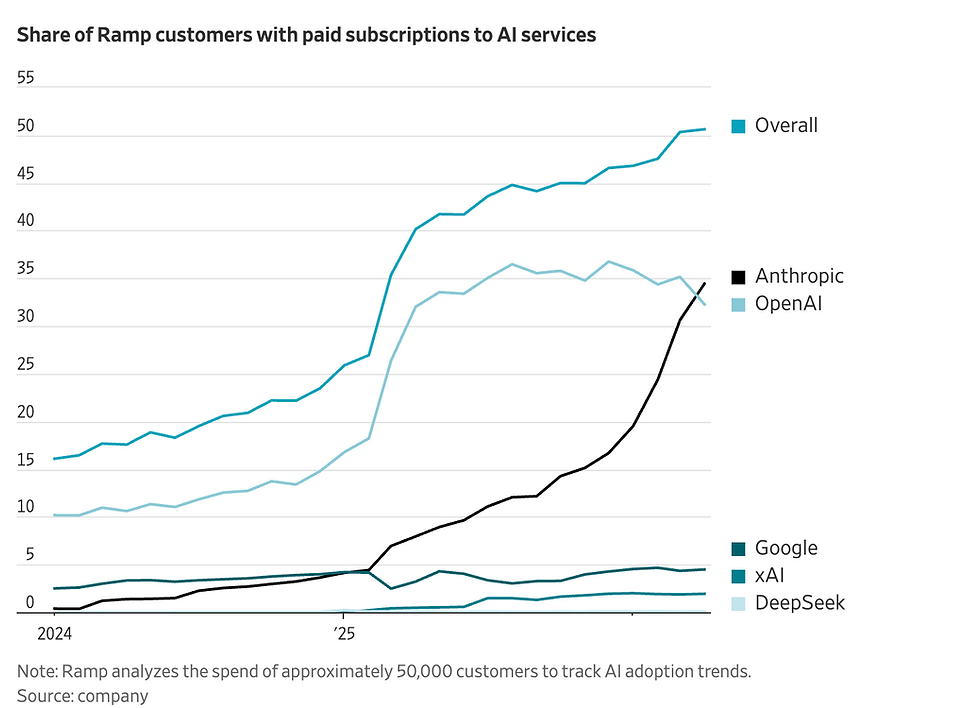
In data released Wednesday, finance startup Ramp said more of its customers used Anthropic’s models than OpenAI’s for the first time, with 34.4% using Anthropic versus 32.3% using OpenAI. Adoption of Anthropic’s Claude tools jumped 3.8% from March to April, while OpenAI adoption fell 2.9%, according to the data. Ramp analyzes the spend of approximately 50,000 customers to track AI adoption trends.
“We’ve seen time and time again in this market that a large dominant player can be unseated in a matter of a couple months,” said Ara Kharazian, lead economist in Ramp’s economics lab. “Anthropic has just done that.”
An OpenAI spokesman said the Ramp figures offer an incomplete picture of business customers because large enterprise clients don’t pay for software services through credit cards. Bloomberg earlier reported on Anthropic’s fundraising offers.
The AI race is far from over, and both companies face challenges, including the looming threat of Google. For Anthropic in particular, computing constraints have caused outages and forced it to throttle users, while OpenAI’s Codex is rapidly gaining popularity, adding pressure as Anthropic struggles to keep pace with its own growth.
Before this year, OpenAI had long been seen as the default front-runner in the AI race, and its ChatGPT chatbot still maintains a sizable lead over Anthropic’s Claude in overall users.
Anthropic has caught up by focusing on developing a handful of products rather than trying to dominate every corner of the market, and its success with coding users and businesses has reset the AI race on its terms.
Doing more with less
Anthropic was founded in 2021 by a group of former OpenAI employees, including siblings Dario and Daniela Amodei, who clashed with OpenAI Chief Executive Sam Altman.
Early on, Dario Amodei was conflicted about turning Anthropic’s AI research into a commercial venture, and turned to wealthy philanthropists in the effective altruism movement for early funding.
In the summer of 2022, Anthropic decided not to release an early version of its Claude chatbot after employees objected, fearing it would start a dangerous technology race.
At the same time, the startup’s ties to effective altruism came under scrutiny because of its connections to disgraced cryptocurrency executive Sam Bankman-Fried, who was convicted of fraud. The relationship made it a pariah to many mainstream investors, while OpenAI rocketed ahead after releasing ChatGPT in late 2022, quickly becoming the industry’s anointed winner and attracting a flood of capital.
Anthropic, forced into a more disciplined state, focused its efforts on building AI tools for business customers.
Back then, “there wasn’t billions of dollars showing up,” Anthropic investor Divesh Makan, founder of Iconiq, said in an earlier interview. “They had to always wake up thinking, how do I do more with less?”
Leading indicators
Anthropic’s growth accelerated sharply in late 2025, around the release of Claude Opus 4.5, a model whose coding capabilities helped drive a surge in adoption of Claude Code, a software tool that works in conjunction with Anthropic’s top AI model. Over the holidays, developers and AI enthusiasts spent hours tinkering with the tool and said they were “Claude-pilled,” or addicted to the product.
Growth picked up even more upon the release of Cowork, Anthropic’s agentic tool for nontechnical tasks, in January.
Still, OpenAI continues to dwarf Anthropic in consumer reach. OpenAI said in February that ChatGPT had reached 900 million weekly active users.
ChatGPT has continued to significantly outpace Claude in weekly U.S. downloads, though for a brief period in March, Claude sprinted ahead.
On March 2, for the first time, Claude surpassed ChatGPT in weekly U.S. downloads, according to data from Sensor Tower, a web-data firm. Around the same time, U.S. app uninstalls for ChatGPT jumped 295%, which Sensor Tower linked to backlash over OpenAI’s deal with the Defense Department.
Meanwhile, in anticipation of a new fundraising round and, later, an initial public offering, bids, asks and trading activity for Anthropic shares have surged on the secondary market.
On Augment, a private-stock marketplace, trades of Anthropic shares tripled in the first quarter compared with the fourth, placing Anthropic at the number one spot for the first time.
During the same period, OpenAI’s secondary value fell 22% on Augment’s marketplace and trading activity was flat.
“Two AI leads. Opposite directions. Same quarter,” Augment wrote in a blog post.
News Corp, owner of The Wall Street Journal, has a content-licensing partnership with OpenAI.

Comments