Why Working Less Is Becoming the Smart Move
- snitzoid
- Mar 25
- 4 min read
Why Working Less Is Becoming the Smart Move
New global data shows why shorter weeks outperform longer ones.
orld Population Review
Mar 25, 2026
For decades, we’ve been told a simple story: more hours mean more output. But across the world, a quiet experiment is unfolding—one that challenges the very foundation of hustle culture.
Countries, companies, and entire workforces are testing shorter workweeks… and something unexpected is happening. Productivity isn’t falling. In many cases, it’s rising.
What does this mean for where you live, work, or invest your time in the years ahead?
Let’s explore where less work is delivering more.
1. The 4-Day Workweek Leaders: Less Time, More Output
The idea sounds radical—cut one full day of work and expect the same results. Yet in several countries, it’s already happening.
🇮🇸 Iceland ran one of the world’s largest trials between 2015–2019. Over 2,500 workers shifted to shorter weeks with no pay cut—and productivity stayed the same or improved across most workplaces.
🇬🇧 The United Kingdom followed with a major 2022 pilot involving 61 companies. An astonishing 92% chose to continue the 4-day model after the trial.
🇯🇵 Japan, known for long hours, saw Microsoft Japan boost productivity by 40% during a shortened workweek experiment.
Putting it into perspective: These results suggest productivity is less about time spent—and more about how focused that time is.
🔎 Fascinating takeaway: In Iceland today, about 86% of workers have either adopted shorter hours or gained the right to request them.

2. Europe’s Quiet Advantage: Working Less, Living More
Europe has long taken a different approach to work—and the data is hard to ignore.
🇳🇱 The Netherlands has one of the shortest average workweeks in the world, at around 29 hours. Yet it consistently ranks among the top economies in productivity per hour.
🇩🇰 Denmark pairs a ~33-hour workweek with high GDP per capita and strong worker satisfaction.
🇩🇪 Germany works fewer hours than the U.S. annually, but produces more output per hour than most major economies.
Putting it into perspective: Shorter workweeks don’t signal laziness—they often reflect highly optimized systems, strong labor policies, and efficient industries.
🔎 Did you know? Dutch workers produce roughly the same output in 29 hours as many countries do in 40+.

3. The Productivity Paradox: Why Fewer Hours Work Better
At first glance, it seems counterintuitive. How can less time produce equal—or better—results?
The answer lies in human limits.
• Focus drops sharply after 4–6 hours of intense work
• Burnout reduces long-term output
• Meetings and inefficiencies expand to fill available time
🇫🇷 France’s 35-hour workweek law initially sparked skepticism—but over time, productivity per hour remained among the highest globally.
🇸🇪 Sweden experimented with 6-hour workdays in certain sectors, finding improved well-being and lower absenteeism.
🇨🇦 In Canada, companies testing reduced hours reported stronger employee retention and fewer sick days.
Putting it into perspective: When time is constrained, work becomes sharper, not slower.
🔎 Key insight: Parkinson’s Law—“work expands to fill the time available”—may explain why longer weeks often waste more time than they create value.

4. The U.S. Experiment: A Cultural Shift in Progress
The United States remains one of the longest-working developed nations—but change is underway.
🇺🇸 American workers average about 1,800 hours per year—hundreds more than many European counterparts.
Yet pilot programs are growing:
• Tech firms are leading 4-day trials
• Startups are using shorter weeks to attract talent
• Some states are exploring policy-level incentives
Companies like Basecamp and Kickstarter have already adopted reduced schedules—with no drop in output.
Putting it into perspective: In competitive labor markets, time—not salary—is becoming a key bargaining chip.
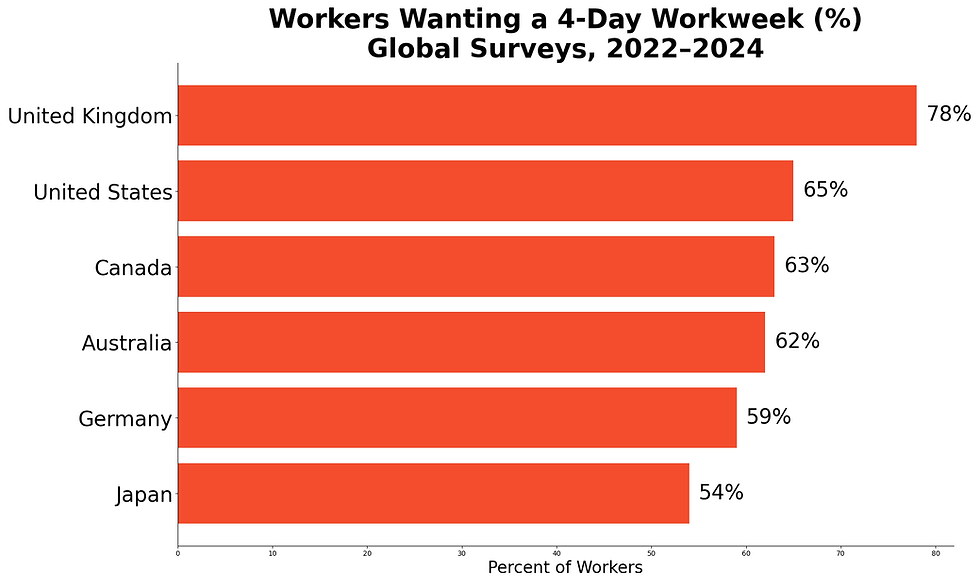
🔎 Trend to watch: Nearly 1 in 3 U.S. workers say they would take a pay cut for a shorter workweek.
5. Asia’s Turning Point: From Overwork to Optimization
Asia presents one of the starkest contrasts—where extreme work culture meets rising reform.
🇰🇷 South Korea once had some of the longest working hours in the world. Recent reforms capped the workweek at 52 hours, with ongoing debates to reduce it further.
🇯🇵 Japan has introduced “Premium Friday” initiatives and workstyle reforms to combat overwork-related health issues.
🇹🇭 Thailand and others are exploring flexible schedules in tourism and service sectors.
Putting it into perspective: Even in cultures built on long hours, the economic and health costs of overwork are forcing change.
🔎 Surprising reality: Japan has a word—karoshi—meaning death from overwork, a key driver behind reform efforts.

6. Remote Work: The Hidden Accelerator
The shift to remote work didn’t just change where we work—it changed how long we work.
During the pandemic:
• Many workers reported longer hours
• But also more flexible schedules
• And increased autonomy over time use
🇦🇺 Australia and 🇳🇿 New Zealand companies have been early adopters of hybrid + shorter-week models.
🇮🇪 Ireland has introduced national pilot programs testing reduced workweeks across industries.
Putting it into perspective: Remote work revealed that productivity is not tied to physical presence—or fixed hours.
🔎 Key shift: Output-based performance is replacing time-based measurement in many modern workplaces.

7. The Future of Work: A New Global Standard?
The 5-day, 40-hour workweek is not as timeless as it seems—it only became standard in the 20th century.
Now, a new model is emerging.
• Governments are funding national trials
• Companies are redesigning workflows
• Workers are prioritizing time over income
Experts suggest that by 2035, shorter workweeks could become standard across many developed economies.
Putting it into perspective: The real competition may no longer be salary—but lifestyle.
🔎 Bold projection: Countries that adopt shorter, more efficient workweeks may attract top global talent—reshaping migration patterns.

The global workweek is being quietly rewritten. What once seemed fringe is now a real economic shift—one that’s shaping where people choose to live, work, and build their future.
The takeaway is simple: time is becoming one of the world’s most valuable currencies. Where it’s respected, life tends to follow.
And in many cases, the biggest changes don’t come from working more—but from working smarter, and sometimes, just a little less.
Comments