Fewer shyster lawyers handling workers comp cases!
- snitzoid
- 2 days ago
- 6 min read
I can't even add up the number of Report writers who've been seriously injured tripping over their desks on route to the bathroom. I've got OSHA up my ass every week. We need our own legal department to deal with this sheet.
Workers Seeking Compensation for Injuries Face New Challenge: Fewer Lawyers
Pool of lawyers pursuing cases is declining in some states after cuts to payouts
By Lauren Weber. WSJ
Aug. 2, 2026 5:30 am ET
The pool of lawyers pursuing workers’ compensation cases is shrinking in some states as state laws have cut payouts and benefits.
FARGO, N.D.—Oak Reile was delivering a pallet of washer fluid, cigarettes and candy to a local convenience store in 2020 when he slipped and fell, breaking two vertebrae and paralyzing him from the armpits down.
After months of hospitalization and rehab, Reile slid into a deep depression. Sometimes he would tell his wife, Kirsten, “You should’ve just let me die,” she says. He started seeing a therapist, but the state workers’ compensation agency denied the claim, arguing depression wasn’t a physiological effect of his injury.
The Reiles, frustrated by other denials too, decided to fight. That was when they discovered another hurdle to getting medical bills paid for on-the-job injuries in North Dakota: There are just two lawyers left in the state who will represent injured workers. Both are in their late 60s and plan to retire soon.
The pool of lawyers pursuing workers’ compensation cases is shrinking in some states. State laws have dialed back payouts and benefits enough that young lawyers are turning to more-lucrative specialties, rather than replacing veteran attorneys who are retiring.
Supporters say workers’ compensation changes, including restricted eligibility for some benefits, have rescued the systems from their insolvency crisis of the 1990s. Some say business-friendly legislatures have left workers unable to get financial relief for accidents beyond minor, inexpensive injuries such as sprains and lacerations.

For businesses, the cutbacks have lowered insurance premiums. Yet workers say they are losing compensation that can be a lifeline for those injured on the job and who face steep medical bills and, sometimes, the loss of steady wages.
“It’s a huge impact to the injured workers that have to live with the results of the injury on their body,” says Chris Godfrey, who was the commissioner of Iowa’s workers’ compensation system from 2006 to 2014 before moving to the U.S. Labor Department, where he oversaw the workers’ comp program for federal employees.
There aren’t national statistics for the number of workers’ compensation lawyers, but Alaska and other states have faced shortages. Last year, New Mexico increased caps on attorney fees to make it easier for workers to find representation.
New lawyers aren’t going into workers’ compensation in North Dakota partly because state laws added to challenges in winning cases, say lawyers and worker advocates. Also, lawyers say the winning awards aren’t big enough to pay for their time and expenses.
Downtown Fargo, N.D.
North Dakota Workforce Safety & Insurance, a public agency that provides and administers the benefits, says changes over the past few decades have helped it recover from a deficit and build a $1.2 billion surplus. Now it routinely issues refunds to employers, which pay the lowest workers’ comp premiums in the country.
WSI says that it approves 90% of initial claims and that its customer-satisfaction score from workers is 4.22 on a scale of 5. Workers who are unhappy with a decision can request a review from an independent office inside WSI, which leads to reversals or settlements in about 10% of the cases brought to it.
Meanwhile, the number of claims has been on a long-term decline even as the workforce grows, reflecting safer workplaces overall, says WSI Director Art Thompson.
“In my opinion, the system is working as well as it’s ever been designed to work,” he says.
Workers and their lawyers say the state rejects many claims for treatments after accepting an initial claim. In addition, few workers appeal denials because they can’t find legal help, says Jaclyn Hall, executive director of the North Dakota Association for Justice, which represents trial lawyers.
Jesse Jerger, a concrete worker in Fargo, fractured his elbow and suffered permanent nerve damage when he fell off a wall during a construction job in 2023. Jerger says after WSI denied some of his claims, both lawyers he spoke to turned him down. One said he was too busy to take the case.
“I just gave up,” says Jerger, 50 years old. “I cashed out a life insurance policy, and I drained what we had in savings to catch up on bills.”
Dan Phillips, one of the state’s two workers’ compensation lawyers, says he receives more than 25 calls each week from workers who want to appeal denials from WSI. He gives advice to as many as he can, he says, but takes only about one case for every six calls he receives.
Workers’ compensation covers medical costs and lost wages for employees hurt on the job. In exchange for the financial relief, injured employees give up their right to sue, a trade-off that became known as the “grand bargain” in the early part of the 20th century. Yet state compensation systems began teetering in the 1990s after they expanded benefits and medical costs ballooned. Insurers threatened to pull out.
WSI ran up a $240 million deficit. To shore up its finances, WSI pulled back on benefits and tightened eligibility standards. North Dakota also rolled back some incentives for lawyers.
As in other states, workers’ attorneys now are paid only when the worker wins. The agency sets rates, such as a $7,455 cap for a successful administrative hearing.
North Dakota’s part-time state legislature has to approve changes to the workers’ compensation statute. Many state lawmakers are business owners, which means they regulate WSI while also paying premiums to it.
Dan Ruby, of Minot, N.D., a state representative for 25 years, runs a sanitation company. In the early 2010s, he paid premiums of around $100,000 annually to cover 25 or so workers, including himself.
Last year, he estimates he paid a little over $10,000 with twice as many employees—thanks to declining rates, dividends from the fund’s surplus and discounts for two safety programs he participates in.
File folders and documents from past and pending cases against WSI spread out on a
Ruby says North Dakota exceeds the national standard on some benefits, such as supplementing Social Security checks for workers whose injuries prevent them from contributing payroll taxes to that system.
“You don’t want people to get hurt,” he says. “But once they do, of course, we want to see them be taken care of.”
The amount of money WSI pays out has been on a long-term slide. It paid $40 million for lost wages last year, down from $79.4 million in 2016. Its outlays for medical benefits also fell during the period.
In all, WSI paid around $500 less, on average, for active claims in 2025—around $4,100 last year, compared with $4,600 in 2016. WSI’s Thompson says that is partly because injuries were more severe a decade ago during North Dakota’s oil boom.
Meanwhile, WSI amassed $2.3 billion in assets by the end of fiscal 2025. Over the past 20 years, it has returned around $1.8 billion to North Dakota-based businesses.
Declining appeals, lawyers
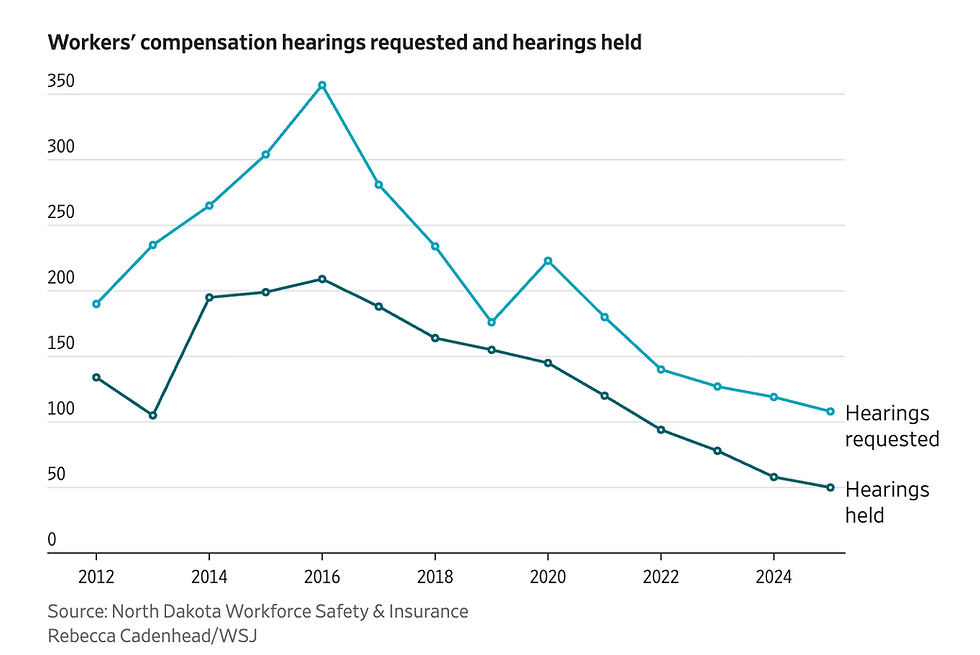
The number of hearings requested by injured workers and employers fell to 108 in 2025, down from 304 hearings 10 years earlier.
Thompson says the requests fell because state law made clearer which benefits workers are entitled to. Workers and their advocates say many workers give up in frustration.
Reile battled WSI for six months to get a $150 cushion for his wheelchair, he says. In 2023, he and his wife challenged WSI’s refusal to cover Oak’s twice-monthly psychotherapy appointments, which cost around $250 each.
He hired Dan Phillips as his lawyer to fight for coverage of the therapy visits. They took the case all the way to the North Dakota Supreme Court—and won.
Reile in his kitchen, which has been adapted to accommodate his needs. His power wheelchair mostly stays in the garage because it is hard to get into the house.
Several days later, at WSI’s request, a state senator added an amendment to legislation that would close the door on future claims seeking coverage for the psychological effects of a work injury. The legislature passed the bill last year.
For his work on Oak Reile’s case, which included an initial administrative hearing, a district court case and the Supreme Court appeal, Phillips says he earned $14,595 in fees. He estimates that was about half the total value of his time.
Phillips and Dean Haas, the other workers’ compensation lawyer in North Dakota, are 67 and 68, respectively. Haas has already cut his practice to part-time, and Phillips hopes to retire in three years. “So pretty soon, there will be zero attorneys in North Dakota doing workers’ comp,” Phillips says.
Comments